
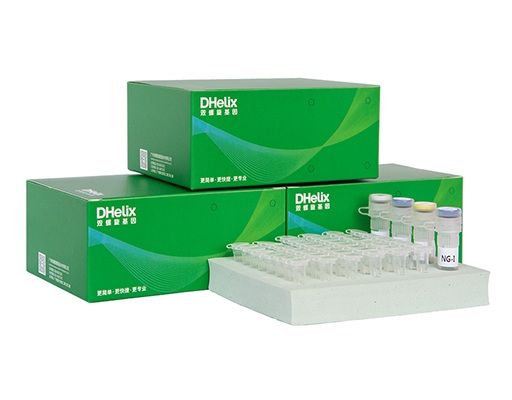
pCaMV35S gene nucleic acid detection kit: 1-Hour Rapid On-Site qPCR Screening
pCaMV35S gene nucleic acid detection kit by DHelix is a highly sensitive real-time PCR (qPCR)-based kit for rapid screening of genetically modified crops and ingredients in agricultural supply chains.
 1-Hour Rapid Result: Get 1-hour on-site qPCR data—100% compatible with mainstream PCR systems from Bio-Rad & Thermo Fisher.
 Maximum Sensitivity: Limit of detection down to 0.01% (or 10 copies) for tracing low-level GMO adventitious presence.
 Zero Cross-Reactivity: 100% elimination of false positives in complex agricultural matrices (raw grains, corn meal, soybean meal, and mixed feeds).
 Industrial Internal Control: Perfectly designed to skip tedious official lab delays for private factory self-screening.
Advanced qPCR Technology for GMO Screening and Identity Preservation:
PCR technology has been widely applied in the seed, grain, and feed processing industries for ingredient traceability, trait verification, and supply chain integrity management. With the increasing global demand for non-GMO identity preservation and strict seed purity controls, real-time PCR (qPCR) has become an essential tool for modern agri-commodities risk management.The DHelix GMO Component Identification System is a real-time PCR-based molecular solution designed for accurate and reliable screening of transgenic elements in raw materials and finished products. By integrating optimized primer-probe design and advanced reaction chemistry, this system provides a highly sensitive, specific, and flexible verification platform, supporting raw grain reception and safeguarding operational compliance in commercial processing.Compared to traditional methods, our TaqMan probe-based qPCR ensures zero cross-reactivity and maximum analytical sensitivity, making it the definitive tool for grain sorting, seed purity validation, feed ingredient internal control, and export-compliance screening.
Advanced qPCR Technology for GMO Screening and Identity Preservation:
PCR technology has been widely applied in the seed, grain, and feed processing industries for ingredient traceability, trait verification, and supply chain integrity management. With the increasing global demand for non-GMO identity preservation and strict seed purity controls, real-time PCR (qPCR) has become an essential tool for modern agri-commodities risk management.The DHelix GMO Component Identification System is a real-time PCR-based molecular solution designed for accurate and reliable screening of transgenic elements in raw materials and finished products. By integrating optimized primer-probe design and advanced reaction chemistry, this system provides a highly sensitive, specific, and flexible verification platform, supporting raw grain reception and safeguarding operational compliance in commercial processing.Compared to traditional methods, our TaqMan probe-based qPCR ensures zero cross-reactivity and maximum analytical sensitivity, making it the definitive tool for grain sorting, seed purity validation, feed ingredient internal control, and export-compliance screening.
Why Private Enterprises Trust DHelix GMO Detection Kit:
Rapid Results
Accelerated workflow provides accurate testing data in under 1 hours.
Exceptional Specificity
TaqMan® probe-based strategy ensures zero cross-reactivity.
High Sensitivity
Detects low copy numbers of target transgenic elements for early warning.
User-friendly
Simplified operation requiring minimal hands-on time and training.
Standardized Workflow
Ready-to-use reagents ensure consistency across batches and labs.
GOLD Standard
Advanced TaqMan® technology for maximum diagnostic confidence.
Technical Features & System Highlights:
The system utilizes a probe-based real-time PCR approach, enabling higher specificity and improved tolerance to complex agricultural sample matrices compared to dye-based systems. It allows accurate detection even in samples with low target copy numbers or high background organic interference.
This system supports simultaneous detection of multiple targets within a single reaction (e.g., target GMO transgenic element + plant internal control). The built-in internal control effectively monitors nucleic acid extraction and amplification efficiency, minimizing the risk of false-negative results.
The assay is capable of detecting low copy numbers of target plant nucleic acids with excellent linearity across a wide dynamic range, ensuring reliable performance in both trace contamination screening and high-load verification conditions.
The system supports both absolute quantification (copy number per reaction or per unit volume) and relative quantification strategies, allowing users to evaluate presence and concentration levels under different application scenarios, from raw grains to mixed feeds.
Optimized primers, probes, and reaction conditions ensure high amplification efficiency and consistent results across different batches, instruments, and field operators.
The ready-to-use reagent format simplifies operation procedures, reduces hands-on time, and minimizes contamination risk, making it suitable for routine laboratory testing as well as on-site mobile field laboratories.
Technical Features & System Highlights ((Click to Expand):
The system utilizes a probe-based real-time PCR approach, enabling higher specificity and improved tolerance to complex agricultural sample matrices compared to dye-based systems. It allows accurate detection even in samples with low target copy numbers or high background organic interference.
This system supports simultaneous detection of multiple targets within a single reaction (e.g., target GMO transgenic element + plant internal control). The built-in internal control effectively monitors nucleic acid extraction and amplification efficiency, minimizing the risk of false-negative results.
The assay is capable of detecting low copy numbers of target plant nucleic acids with excellent linearity across a wide dynamic range, ensuring reliable performance in both trace contamination screening and high-load verification conditions.
The system supports both absolute quantification (copy number per reaction or per unit volume) and relative quantification strategies, allowing users to evaluate presence and concentration levels under different application scenarios, from raw grains to mixed feeds.
Optimized primers, probes, and reaction conditions ensure high amplification efficiency and consistent results across different batches, instruments, and field operators.
The ready-to-use reagent format simplifies operation procedures, reduces hands-on time, and minimizes contamination risk, making it suitable for routine laboratory testing as well as on-site mobile field laboratories.
Component Authentication:
The identification of transgenic components is a critical requirement in the global agricultural and feed supply chains, driven by strict non-GMO identity preservation (IP) standards, seed purity regulations, and international trade compliance. Due to the high risk of cross-contamination in grain handling and processing facilities, grain exporters and global testing authorities enforce rigorous control limits on undocumented GMO events. Traditional immunological lateral flow strips lack the analytical sensitivity required for heavily processed matrices or low-level adventitious presence. DHelix’s qPCR assay specifically targets highly conserved, multi-copy genetic promoter and terminator sequences unique to common transgenic traits, maximizing sensitivity down to trace levels. It offers a precise diagnostic solution that delivers actionable data in 45 minutes, empowering quality control managers and private laboratory inspectors to execute definitive internal controls, verify supply chains, and pass export clearance benchmarks flawlessly.
Component Authentication (Click to Expand):
The identification of transgenic components is a critical requirement in the global agricultural and feed supply chains, driven by strict non-GMO identity preservation (IP) standards, seed purity regulations, and international trade compliance. Due to the high risk of cross-contamination in grain handling and processing facilities, grain exporters and global testing authorities enforce rigorous control limits on undocumented GMO events. Traditional immunological lateral flow strips lack the analytical sensitivity required for heavily processed matrices or low-level adventitious presence. DHelix’s qPCR assay specifically targets highly conserved, multi-copy genetic promoter and terminator sequences unique to common transgenic traits, maximizing sensitivity down to trace levels. It offers a precise diagnostic solution that delivers actionable data in 45 minutes, empowering quality control managers and private laboratory inspectors to execute definitive internal controls, verify supply chains, and pass export clearance benchmarks flawlessly.
pCaMV35S Gene Detection Kit Specifications & GMO Screening Workflow:
- Catalog No.:041142M
- Format: 48 T
- Description: This kit is used for the rapid screening and qualitative detection of pCaMV35S promoter sequences in plant-derived components and agricultural raw materials.
- Sample Types:Validated Agricultural & Processing Matrices: Raw Grains & Oilseeds (Corn kernels, whole soybeans, canola seeds); Bulk Feed Ingredients (Corn meal, soybean meal, DDGS, wheat bran, and plant-derived proteins); Processed Food & Feed Products (Mixed commercial feeds, corn starch, soy flour, and various complex plant-derived matrices).
- Protocol: 1. Sample Preparation & DNA Extraction; 2. Reagents Preparation; 3. Amplification Reaction (qPCR); 4. Data Analysis.
Handling Precautions & Storage(Click to Expand):
1. Storage Temperature: This reagent kit should be stored at -20°C. To prevent the reagents from deterioration, only take out the necessary amount of reagents from the freezer before use (In order to maintain the reagents’ performance, avoid unnecessary freezing and thawing).
2. Reagent Preparation: Thaw the reagents at room temperature. Before use, spin down the tubes to drop down the reagents staying on the tube wall or on the cap, and mix well the reagents and spin down again. Notice that fierce mixing should be avoided as it can inactivate the Taq DNA Polymerase.
3. Contamination Control: Positive Control contains a high number of copies. In order to prevent Positive Control from contaminating other samples or reagents, always spin down before opening the tube and open the cap of the tube as short as possible. Also add into the reaction tubes under the following order from blank control, sample solution (extracted DNA), and leave the adding of positive control to the last and make sure that all other tube caps are closed when adding it. Moreover, to avoid contamination, do not use Positive Control in any other way not written in this instruction (such as diluting the positive control or adding it to samples).
4. Segregation Policy: Keep positive control and suspect positive samples away from the reagents when handling.
5. Batch Integrity: If there is any reagent left, do not use it with other kits even if they are in the same lot.
6. Amplicon Management: The caps of the used reaction tubes should not be opened. Pay special attention not to accidentally open the cap when taking the tubes out of the instrument. Contamination of amplified products on other samples may not only cause false judgment of the test result but also pollute the testing area. In this case, a correct test result may not be obtained unless pollution is completely removed.
7. Disposal Protocol: Keep the cap of the used tube completely closed and after double bagging it with the sealable vinyl bag. To prevent the amplified products from dispersing, do not conduct autoclave sterilization treatment for disposal.
8. Tube Physical Maintenance: This kit should be stored at -20°C. Storing the kit at a temperature lower than -20°C or repeated freezing and thawing might cause cracks on the tubes.
Inquiry For pCaMV35S gene nucleic acid detection kit
We will provide a quote within 24 hours.
This site is protected by reCAPTCHA and the Google Privacy Policy and Terms of Service apply.